
The value of sustainable businesses is often discussed as though it exists in a steady state.
A green widget manufacturer is often assumed to command a persistent valuation premium over its conventional equivalent. Some investors may be willing to pay more because of environmental benefits, regulatory tailwinds and stronger long-term commercial prospects.
Reality, however, is more dynamic.
The financial value investors attach to sustainability changes over time. One overlooked driver may not be impact investors at all.
Instead, it may be uncertainty in the oil market.
Why oil prices matter
A recent paper by Nawaz et al. (2026) examines the relationship between oil price uncertainty and sustainable finance over the period 2014–2024.
Using advanced econometric techniques, the authors find that periods of elevated oil price uncertainty are associated with stronger performance of both:
- green bond markets; and
- clean energy equities,
particularly over medium- and long-term horizons.
The intuition is straightforward.
When oil markets become more uncertain, investors begin questioning the long-term risks associated with fossil fuel exposure. Some seek to hedge that risk by increasing allocations to sustainable assets, while others make a more structural shift towards renewable energy and other energy transition-related investments.
Greater investor demand can, in turn, support the valuation of sustainable assets.
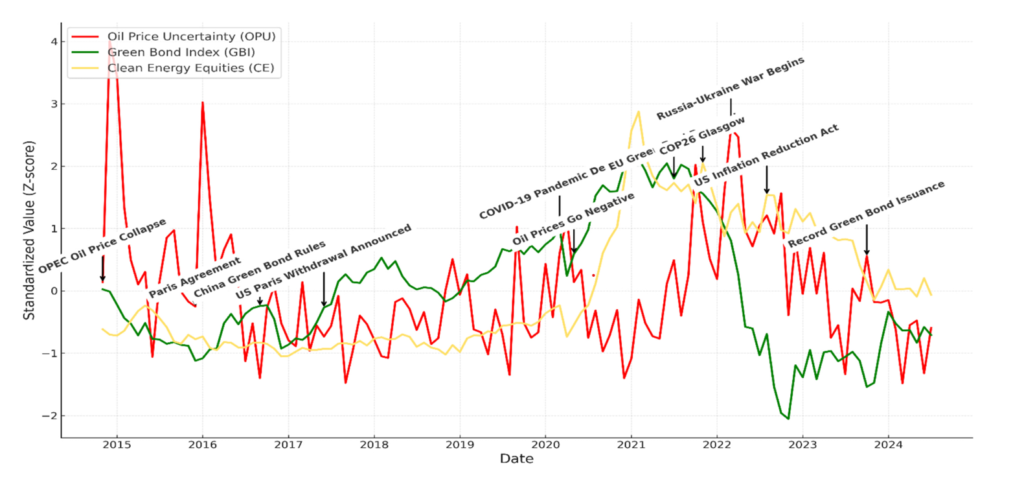
Oil price uncertainty, the S&P Green Bond Index and the S&P Global Clean Energy Transition Index (2014–2024). Source: Nawaz et al. (2026).
What this means for valuations
For valuation professionals, this provides an important reminder.
The value of a green business should not simply be viewed as a conventional valuation plus a fixed sustainability premium.
Instead, sustainability-related value should be viewed as a variable that evolves alongside macroeconomic conditions, investor preferences and the pace of the energy transition.
Oil price uncertainty is therefore not merely an input into forecasting future energy costs. It may also influence the discount rates, market multiples and investor demand applied to sustainable businesses—for as long as oil continues to play a central role in the global economy.
Looking ahead
The world once again faces heightened uncertainty in global energy markets.
Could this have a silver lining?
Persistent oil price volatility may continue to strengthen investor demand for sustainable finance and, in doing so, support the value of sustainable businesses.
For investors, this matters for portfolio allocation.
For businesses, it affects access to capital.
And for valuation specialists, it serves as a reminder that sustainability should not be treated as a static valuation adjustment. It is an evolving market factor whose value changes with investor preferences, macroeconomic conditions and the pace of the energy transition.
References
- Nawaz, A., Su, C. W., Shah, S. A., & Du, Y. (2026). Does oil price uncertainty relate to sustainable finance? Evidence from green bonds and clean energy equities. International Review of Financial Analysis, 115, 105184.