
Independent valuations throughout the business lifecycle
The value of a business matters at many stages of its development — from raising capital and rewarding employees to acquisitions, succession planning and eventual sale.
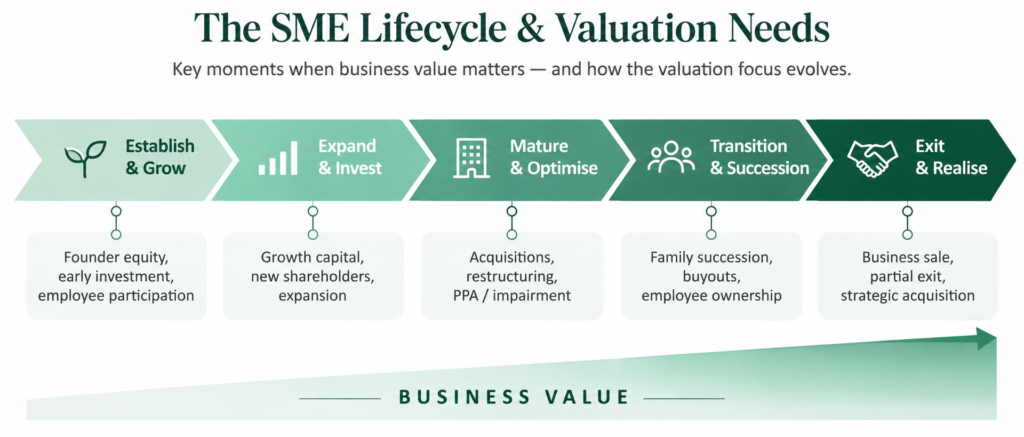
At Sustainable Valuations, we provide independent business valuations for small and medium-sized enterprises (SMEs), helping owners, management teams and their professional advisers make informed financial and strategic decisions.
Our approach recognises that valuation is not simply about determining what a business might sell for. Different decisions require different perspectives on value.
Valuation needs across the SME lifecycle
1. Establishment & Early Growth
In the early stages, businesses are often founder-led, with limited financial history and significant uncertainty around future performance.
Typical valuation needs: Founder equity arrangements, bringing in investors, employee share participation and establishing an initial business value.
Valuation considerations: Greater emphasis on future earnings potential, growth assumptions and risk, rather than historical financial performance. Valuations may be relatively indicative or require more formal analysis depending on their purpose.
2. Growth & Expansion
As a business develops a track record, its valuation becomes increasingly relevant for investment, financing and strategic decisions.
Typical valuation needs: Raising growth capital, introducing new shareholders, management incentive plans and evaluating expansion opportunities.
Valuation considerations: Increasing reliance on historical performance, cash flow forecasts and comparable businesses. Independent valuations can help establish a credible basis for negotiations and ownership arrangements.
3. Maturity & Strategic Development
Established SMEs often have more predictable earnings, established market positions and increasingly complex ownership or organisational structures.
Typical valuation needs: Acquisitions, restructuring, shareholder transactions, strategic reviews, purchase price allocation and impairment testing.
Valuation considerations: Greater focus on sustainable earnings, cash generation, market comparables and business-specific risks. Valuations may also need to satisfy accounting, governance or other formal requirements.
4. Ownership Changes & Succession
Ownership changes can occur at any stage, but often become particularly important as businesses mature and founders consider their longer-term plans.
Typical valuation needs: Family succession, gifts and inheritance, shareholder buyouts, management buyouts, employee ownership and shareholder disputes.
Valuation considerations: The purpose of the transfer becomes especially important. A valuation for a family transfer or tax purpose may differ from the price achievable in a commercial sale. Independent appraisers can provide an objective and defensible basis for discussions between owners, successors and advisers.
5. Exit, Sale & Transition
When owners consider selling all or part of their business, understanding its value becomes central to preparing for and negotiating a transaction.
Typical valuation needs: Business sales, partial exits, management buyouts, strategic acquisitions and ownership transfers.
Valuation considerations: Market conditions, potential buyers, transaction structure and buyer-specific synergies can all influence achievable value. An independent valuation can help owners understand a reasonable valuation range, while transaction advisers and potential buyers provide additional perspectives on market pricing.
Why the Purpose of a Valuation Matters
A privately owned business can have different values depending on the question being asked.
For example:
- Owner value: What is the business worth to its current owner, considering its future earnings and personal objectives?
- Investment value: What might the business be worth to a particular investor or acquirer?
- Market value: What price might be achievable through a sale to potential buyers?
- Valuations for tax, legal or accounting purposes: What value is appropriate under the relevant rules, standards and circumstances?
These distinctions are important. A family succession, shareholder dispute and competitive business sale may each require a different valuation perspective, even for the same company.
Understanding the purpose of the valuation is therefore the starting point for selecting the appropriate approach.
How We Can Help
Sustainable Valuations provides independent valuation expertise tailored to the circumstances of each business.
Our services include:
- Independent SME and shareholder valuations
- Valuations for succession and ownership transfers
- Strategic and transaction-related valuations
- Valuations supporting financial reporting and accounting requirements
- Valuation reviews and second opinions
We work directly with business owners and management teams, as well as alongside accountants, tax advisers, lawyers and other professional advisers.
Our aim is to provide clear, practical and well-supported valuations that help clients make informed decisions.
Discuss Your Valuation Needs
Whether you are considering an ownership change, planning for succession, evaluating an acquisition or require a valuation for a specific financial or regulatory purpose, we would welcome an initial conversation.
Contact Sustainable Valuations to discuss how we can support your business.